What a CDN is and whether your site needs one? We explain in plain words
When speeding up sites, the acronym CDN often comes up. It sounds like something for IT people, but the idea behind it is very simple and worth understanding, because for some sites a CDN makes a genuinely noticeable difference. Let us explain it without jargon.
The problem: distance matters
Your site physically "lives" on a server in a specific place, say a data centre near Warsaw. When someone from Krakow visits, the data has to travel from the server to their browser. For someone in Warsaw that is a flash. But for a visitor from Berlin, London or New York that journey is much longer, and every kilometre is fractions of a second of delay that add up.
The solution: copies of the site closer to people
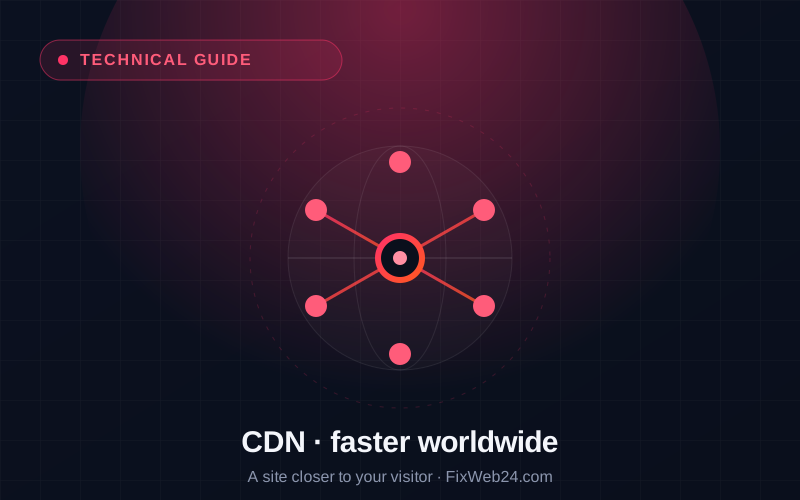
A CDN (Content Delivery Network) is a network of servers scattered around the world. Instead of always serving the site from one place, the CDN keeps copies of it in many locations at once. When someone visits the site, they get it from the server nearest them.
Imagine that instead of one warehouse in one city, you have a small warehouse in every major city. The customer gets the parcel from the nearest one, faster and more reliably. A CDN does exactly that with your site.
What it gives you in practice
- Faster loading: especially for visitors from more distant locations. The site is simply closer.
- Greater stability: traffic is spread across many servers, so a sudden spike in visits (e.g. a successful campaign) puts less load on your main server.
- Offloading your hosting: part of the work (serving images, files) is taken over by the CDN, so your server has it easier.
- An extra layer of protection: many CDNs also help repel some attacks (e.g. attempts to overload the site), because they stand "in front of" your server.
Does your site need one?
It depends, and the honest answer is: not always.
- A CDN helps a lot if you have visitors from various regions or countries, a lot of graphics, a shop, or occasional traffic spikes.
- A CDN gives less if your customers are exclusively local (e.g. services in one city) and the server is in the same country. Then the difference can be small and it is better to first deal with the basics: image optimisation and cache.
In other words: a CDN is a great tool, but not a magic "faster" switch for every site. First it is worth putting the fundamentals in order and treating a CDN as the next step where it genuinely adds something.
The good news: setup can be simple
Many CDNs (like the popular Cloudflare) can be launched without rebuilding the site, sometimes a change of domain settings is enough. Some offer a free plan that is entirely sufficient for a small business site. The only key thing is matching the solution to a real need, rather than switching everything on "just in case".
Not sure whether your site would benefit from a CDN or whether something else is worth improving first? Get in touch, we will check what would genuinely speed up your particular site.